Freud vs. Predictive Processing Theory: How Two Very Different Ideas Meet Around the Human Mind
Freud vs. Predictive Processing Theory: How Two Very Different Ideas Meet Around the Human Mind
Introduction
Did neuroscience just prove Freud right? Not quite but predictive processing theory, one of the most influential frameworks in modern neuroscience, overlaps with Freudian psychology in a way few people expect. Both agree that most of what shapes our thoughts, feelings, and reactions happens outside conscious awareness. Both agree that we don't perceive reality directly. We perceive our expectations of reality, corrected only when the world pushes back hard enough. Where they part ways is just as important as where they meet, and understanding both sides is what makes the comparison worth making.
Sigmund Freud developed his ideas as a physician and psychologist at the turn of the twentieth century, long before brain imaging or computational neuroscience existed. Predictive processing is a contemporary framework built from computational modeling, cognitive science, and neuroscience. On the surface, these look like theories from different planets. But researchers and philosophers keep circling back to the same observation: both insist that conscious awareness is only a thin slice of mental life, and both argue that what we experience is shaped as much by internal expectation as by external reality.
That said, similarity is not proof. Predictive processing has not validated Freud's entire psychological system. It offers a modern scientific lens that happens to overlap with some Freudian ideas while directly contradicting others. Reading both side by side says less about Freud being "right" and more about how psychology has moved from clinical interpretation toward computational and neuroscientific explanation.
What Freud Was Trying to Explain
Freud's central question was simple: why do people behave in ways they don't fully understand?
People sabotage relationships, repeat unhealthy patterns, fear things that pose no real danger, and have dreams that feel emotionally loaded. Freud didn't think conscious reasoning alone could account for any of this. His answer was the unconscious mind is a reservoir of thoughts, emotions, memories, and desires that shapes behavior without ever surfacing into awareness. Not simply forgotten facts, but active psychological forces steering how people interpret situations and relate to others.
Freud built this idea through clinical observation rather than controlled experiment and years of noticing recurring emotional patterns, symbolic dreams, and repeated relationship dynamics across patients. It's rich, influential evidence, but it's interpretive, not experimental, which is the single biggest methodological gap between Freud and everything that follows in this article.
Two Freudian concepts matter most for this comparison:
Projection i.e. attributing your own feelings to someone else instead of recognizing them in yourself. Someone secretly jealous of a colleague, for instance, may become convinced the colleague envies them instead. Freud saw this as a way of moving uncomfortable emotions outside conscious awareness to protect self-image.
Transference or responding to a new person as though they were an important figure from your past. Someone raised by a highly critical parent might brace for criticism from a new boss who has given no actual sign of being judgmental. Transference remains a working concept in psychotherapy today, and there's solid clinical evidence that people repeat interpersonal patterns across relationships though modern researchers explain this through several frameworks, not Freud's alone.
What Predictive Processing Theory Says
Predictive processing starts from a different question: how does the brain make sense of an uncertain world?
Our senses never hand us a complete picture. Vision has blind spots, hearing is partial, memory is lossy. If the brain waited for full information before acting, everyday life would grind to a halt. So instead, predictive processing proposes the brain is constantly generating educated guesses built from generative models, its internal working theory of how the world behaves, assembled from past experience and current context.
Walk into your own kitchen in the dark and you'll reach for the light switch without groping the wall your brain already predicted where it should be. That's the model working correctly. But if someone moves the switch during a renovation, your hand lands on nothing. The gap between what you expected and what actually happened is a prediction error, and it's the central mechanism of the whole theory.
Rather than treating errors as failures, the brain treats them as learning signals: large enough prediction errors trigger a model update. This has support from computational neuroscience, perception experiments, and brain-activity studies showing the brain continuously checks expectation against incoming sensory data though predictive processing is still an evolving framework, not a settled final theory of brain function.
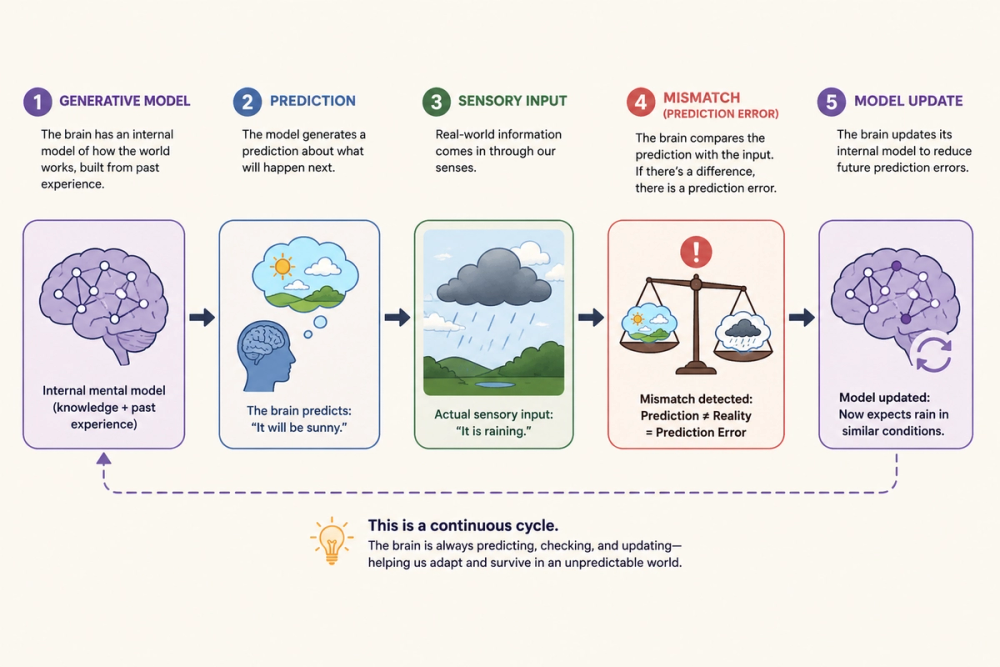
The theory also reframes homeostasis ( the body's effort to keep internal conditions like temperature, blood sugar, and hydration stable.) Instead of only reacting once something goes wrong, predictive processing argues the brain often predicts future needs and prepares ahead of time. You start feeling hungry before your energy runs critically low, because your brain is anticipating, not just responding.
Where the Two Theories Overlap
The strongest point of contact is unconscious processing. Freud located unconscious conflict at the root of conscious experience; predictive processing locates unconscious statistical inference there instead. Both claims are well supported in the sense that modern psychology and neuroscience consistently show attention, perception, emotion, and motor control running automatically, outside awareness but the content of what's happening unconsciously is where the two theories diverge. Freud: wishes, conflicts, defenses. Predictive processing: inference and prediction. Not the same claim, even though both start in the dark.
The second overlap is interpretation. Neither theory treats perception as neutral recording. Waiting for an important text message, every phone vibration grabs your attention sometimes you're convinced it buzzed when it didn't. Freud would frame this as desire coloring awareness. Predictive processing would call it a strong expectation biasing detection toward an anticipated signal. Different mechanisms, same underlying claim: expectation shapes experience.
The pattern repeats in social anxiety. Someone who walks into a party already convinced nobody likes them will read neutral expressions as rejection and notice silence more than warmth. Research on anxiety disorders backs the general phenomenon solidly. Anxious people do tend to expect threat and interpret ambiguous situations negatively. What's still genuinely open is which explanation fits better: unresolved emotional conflict, or biased prior expectation. That's a live debate, not a settled one.
Daily-Life Examples
Relationship misreads. A partner sends a short reply because they're slammed at work. One read: "they're upset with me." Predictive processing calls this the brain filling a gap with prior expectation. Freud would push further and ask what earlier experience maybe a fear of abandonment built that expectation in the first place. Neither theory treats the interpretation as neutral.
Dreams. Freud argued dreams encode unconscious wishes through symbolism. Modern dream research doesn't really back that up, evidence points instead toward memory consolidation and emotional processing during sleep. Some predictive-processing researchers speculate dreams might help the brain refine its internal models while cut off from sensory input, but that's an interesting hypothesis, not an established fact.
Fear. A loud noise downstairs at night triggers a danger prediction before you've gathered any real evidence such as racing heart, tensed muscles and only afterward do you find the cat knocked something over. Predictive processing: a threat prediction fired ahead of confirmation. Freud: personal history, maybe past trauma, may be amplifying the reaction.
Habits. Driving the familiar route home barely requires conscious thought. Predictive processing explains this as an efficient, well-trained prediction loop, and this is the one place in the whole comparison where predictive processing has the clearly stronger empirical footing, it lines up directly with established research on procedural memory and motor learning, an area Freud's framework was never built to address.
Why the Comparison Matters
Both theories challenge the assumption that we simply "see things as they are." In therapy, that's not just a philosophical point, it's practical. A therapist helping someone notice a recurring belief like "people always reject me" can frame it through either lens. Predictive processing treats it as a powerful prior expectation biasing perception. Psychodynamic therapy digs into where that expectation originated emotionally. Cognitive approaches test the prediction directly against reality. Different vocabularies, frequently the same underlying pattern.
Chronic anxiety is a good test case. An anxious brain predicts danger ahead of the evidence; repeated prediction errors or a lack of corrective experien-ce reinforce the fearful expectation over time. That mechanism has strong backing from cognitive psychology and neuroscience. Freud would likely reach for unconscious conflict instead. Different explanations, same encouragement: examine the hidden assumption before trusting the automatic reaction.
Where the Comparison Breaks Down
The overlap has real limits, and it's worth being blunt about them.
Freud's theory is about motivation, conflict, sexuality, childhood, and symbolic meaning. Predictive processing is a theory about information processing, perception, and learning. Different explanatory targets entirely.
The evidence standards aren't close, either. Freud worked from clinical interpretation; predictive processing works from computational modeling, controlled experiments, and neuroscience. Classic Freudian claims repression, dream symbolism, psychosexual development have received mixed-to-weak empirical support, and some have fallen out of mainstream scientific psychology entirely, even as core concepts like transference persist in clinical practice.
Predictive processing has its own open critiques. Some researchers argue it's broad enough to explain almost any finding after the fact, which makes parts of it hard to falsify. Whether prediction alone accounts for everything the brain does is still contested.
The bottom line: shared emphasis on unconscious process is not proof that predictive processing validates Freud's system. This comparison is an intellectual bridge, not scientific confirmation and treating it as more than that misrepresents both theories.
Common Questions
Did neuroscience prove Freud was right? No. Predictive processing shares Freud's emphasis on unconscious processing and expectation-driven perception, but it explains the mechanism very differently as statistical inference rather than emotional conflict and it directly contradicts several core Freudian claims, including most of his dream theory.
What is predictive processing theory, in simple terms? It's the idea that the brain doesn't passively record the world it constantly predicts what's about to happen, checks those predictions against incoming sensory information, and updates its internal model whenever reality doesn't match the guess.
Is Freud's theory still considered scientific? Parts of it, like transference, remain clinically useful and are supported by observational evidence. Other parts, like dream symbolism and repression as originally formulated, have weak empirical support and aren't part of mainstream cognitive science today.
Why compare a 100-year-old psychological theory to modern neuroscience? Because both, despite entirely different methods and eras, converge on the same unsettling idea: most of what shapes your experience happens before you're aware of it, and what you perceive is filtered through expectation rather than recorded neutrally.
Conclusion
Freud and predictive processing come from different eras of psychology entirely, one seeking to explain hidden emotional conflict, the other seeking to explain how the brain constructs perception through continuous prediction. Their overlap is real: both minimize the role of conscious awareness, both treat expectation as a shaping force, both push back against the idea that perception is objective. Their differences are just as real: symbolic meaning and clinical interpretation on one side, computational models and prediction error on the other.
The lesson worth keeping is the shared one. Our minds don't record reality, they interpret it. Whether that interpretation comes from emotional history, predictive brain models, or some combination neither theory fully captures on its own, learning to notice it is what actually improves how we relate to other people and to our own reactions.
You might also like
Neuroplasticity And Negative Self-Talk
Your brain rewires itself for life. Learn what neuroplasticity really is, with real examples.
6 min readEmotional Outsourcing: What It Is, Why We Do It, and How to Build Emotional Independence
Learn what emotional outsourcing is, why it happens, its warning signs, and practical ways to build emotional independence and healthier relationships.
5 min readHow Wearable Sensors Actually Track Sleep Stages (And Where the Science Gets Fuzzy)
Wearables don't read brain waves. Here's how sensors estimate light, deep, and REM sleep, what the validation research shows, and where accuracy falls short.
7 min read