Emotional Outsourcing: What It Is, Why We Do It, and How to Build Emotional Independence
Emotional Outsourcing: What It Is, Why We Do It, and How to Build Emotional Independence
Introduction
We all need people.
We need friends to celebrate with, family to comfort us, and partners to share life's ups and downs. Human connection is one of our greatest psychological needs. But sometimes, without realizing it, we begin depending on someone else not just for support but for our emotional stability.
This is known as emotional outsourcing.
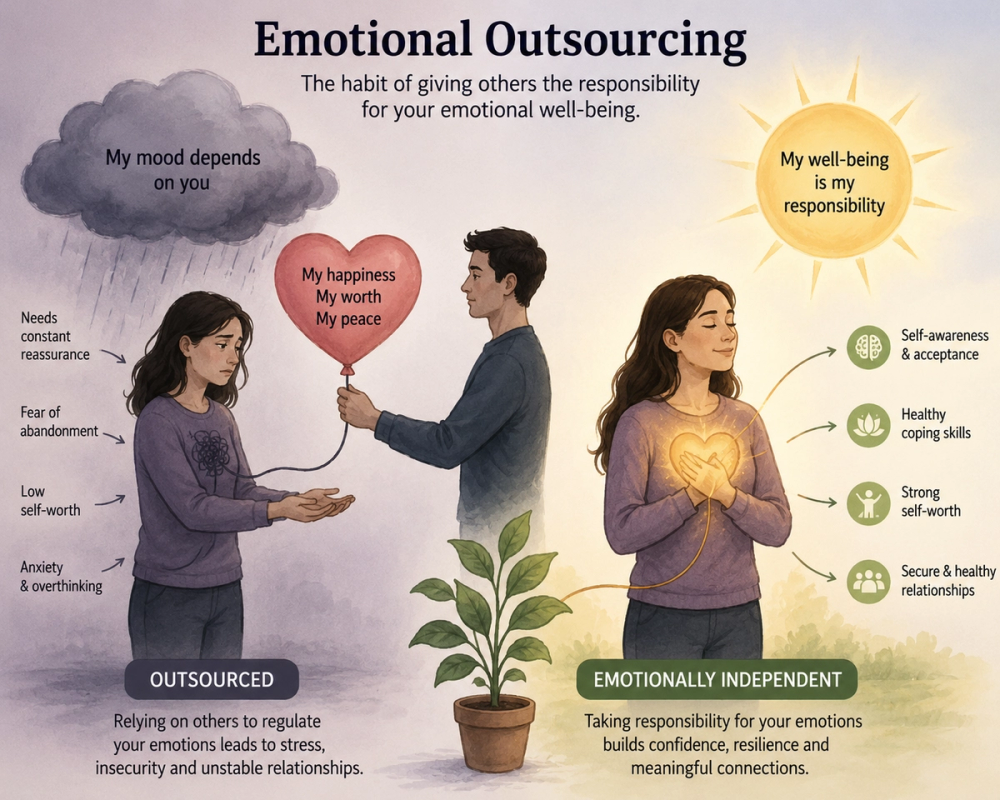
Emotional outsourcing happens when we expect another person to manage our feelings, validate our worth, or make us happy. While support from others is healthy, relying on someone else to regulate your emotions can create unhealthy relationships, disappointment, and emotional exhaustion. Understanding emotional outsourcing can help you build healthier relationships, become more emotionally resilient, and feel more in control of your own well-being.
What Is Emotional Outsourcing?
Emotional outsourcing means placing the responsibility for your emotional well-being into someone else's hands. Instead of learning to manage your own feelings, you unconsciously expect another person to make you feel better, calmer, happier, or more confident. Think of it like outsourcing work in a business. A company hires another company to handle certain tasks. Emotional outsourcing works in a similar way. You hand over the "job" of managing your emotions to another person. The problem is that no one can consistently do that job for you. Everyone has their own emotions, responsibilities, and struggles.
Emotional Support vs. Emotional Outsourcing
These two ideas sound similar, but they are very different. Healthy emotional support is an essential part of every strong relationship. Talking to a friend after a stressful day, asking your partner for comfort after losing your job, or calling a family member when you feel overwhelmed are all healthy examples of sharing emotions. In these situations, you are seeking support while still taking responsibility for your own emotional well-being.
Emotional outsourcing is different. It happens when your emotional state depends almost entirely on someone else's actions. You may feel worthless unless your partner constantly reassures you, become anxious whenever someone doesn't reply quickly, expect a friend to fix every bad mood, or believe another person is responsible for your happiness. In these situations, another person's behavior begins to control how you feel, and that creates an unhealthy emotional imbalance.
Why Do People Emotionally Outsource?
Emotional outsourcing rarely happens because someone is weak or incapable. More often, it develops gradually through life experiences. Some people fear being alone and feel emotionally unsafe without another person's presence. Silence feels uncomfortable, and they begin relying on someone else to feel secure.
Low self-esteem is another common reason. If you struggle to believe in your own worth, you may constantly look to others for reassurance. Compliments become necessary rather than simply enjoyable, and without regular validation, self-doubt quickly returns.
Childhood experiences can also shape this pattern. As children, we naturally depend on parents to help regulate our emotions. Psychiatrist and attachment researcher John Bowlby argued that our earliest relationships shape how we connect with others throughout life. Children who experience consistent care often develop a secure sense of emotional safety, while inconsistent or unreliable care can make reassurance feel like something that must constantly be sought rather than quietly trusted. Healthy caregivers gradually teach children how to recognize and manage feelings on their own. If that process is interrupted, some people grow into adults who still expect another person to regulate their emotional world.
Modern culture sometimes reinforces these beliefs. Movies, novels, and social media often celebrate ideas such as "You complete me" or "I can't live without you." While these statements sound romantic, they can encourage emotional dependence instead of healthy love. Strong relationships involve two emotionally responsible people supporting one another, not just one person carrying the emotional weight of both.
Signs You May Be Emotionally Outsourcing
Many people emotionally outsource without realizing it. One common sign is that your mood depends almost entirely on one person's attention. If they text you, your day suddenly feels wonderful. If they don't, your mood crashes. Another sign is constantly seeking reassurance by repeatedly asking questions like, "Are you mad at me?" or "Do you still love me?" Occasional reassurance is completely normal, but needing it every day may suggest that your emotional security has become dependent on someone else.
Some people also find it difficult to make decisions without approval from others, even when the choices are small. Others feel emotionally lost after a breakup or friendship ends because they have lost not only the relationship but also their sense of identity. Emotional outsourcing can also appear as blaming other people for your emotions, believing they are entirely responsible for your happiness or sadness. Although people certainly influence how we feel, they can never be fully responsible for our emotional well-being.
Real-Life Examples of Emotional Outsourcing
Imagine that Sara sends a message to someone she likes. After two hours without a reply, she becomes anxious and starts imagining the worst. She checks her phone every few minutes, loses focus on her evening, and convinces herself she is being ignored. The following morning she discovers that the other person was simply busy at work. Her emotional state became dependent on someone else's response rather than the reality of the situation.
Now consider Ahmed, who asks his partner several times each week if they still love him. His partner reassures him every time, but the comfort lasts only a few hours before the same doubts return. Instead of solving his insecurity, reassurance becomes temporary emotional relief.
Another example is Ali, who works hard on an important project. His manager forgets to praise him, and despite doing excellent work, Ali spends the rest of the day believing he has failed. His confidence depends entirely on external recognition rather than his own understanding of his abilities.
Why Emotional Outsourcing Can Be Harmful
At first, emotional outsourcing may seem harmless because healthy relationships naturally involve depending on one another from time to time. However, when another person becomes responsible for your emotional stability, several problems begin to appear. Relationships can become emotionally exhausting because one person feels pressured to constantly comfort, reassure, and emotionally support the other. Over time, this responsibility becomes draining.
Emotional outsourcing can also increase anxiety. When your happiness depends on another person's actions, every delayed message, disagreement, or misunderstanding feels like a crisis. At the same time, your self-confidence becomes fragile because it rises and falls depending on external approval instead of your own self-worth. Even small conflicts can grow into major emotional struggles because they threaten the security you have placed in someone else.
Decades of attachment research suggest that people with higher attachment anxiety often seek frequent reassurance from partners. While reassurance can provide temporary comfort, studies show it rarely resolves the underlying insecurity and may even reinforce the cycle over time. This is supported by research from Mario Mikulincer and Phillip Shaver, two leading attachment psychologists.
How to Stop Emotionally Outsourcing
The goal is not to stop relying on people. Healthy relationships are built on mutual support. The goal is to stop making other people responsible for your emotional health.
One helpful first step is learning to notice your emotions before reacting to them. Instead of asking, "Who made me feel this way?" ask yourself, "What exactly am I feeling?" Simply identifying an emotion often reduces its intensity and helps you respond more thoughtfully.
It is equally important to build your own emotional toolbox. Going for a walk, journaling, exercising, practicing deep breathing, spending time on hobbies, or talking to a trusted friend are all healthy ways of regulating emotions. The more coping skills you develop, the less you depend on one person to restore your emotional balance.
Another useful habit is challenging automatic negative thoughts. If someone doesn't reply immediately, resist jumping to conclusions. Instead of assuming they no longer care about you, consider more realistic explanations, such as them being busy or distracted. Small shifts in thinking can prevent unnecessary emotional distress.
Finally, work on building confidence from within. Ask yourself what qualities you genuinely value about yourself rather than waiting for praise from others. Continue investing in your hobbies, friendships, personal goals, and interests. A healthy relationship should enrich your life, not become your entire identity.
"Between stimulus and response there is a space. In that space is our power to choose our response." — Viktor E. Frankl, Man's Search for Meaning
Emotional Independence Does Not Mean Isolation
Some people mistakenly believe that emotional independence means never asking for help or never sharing emotions. In reality, emotionally independent people still seek support during difficult times. The difference is that they do not expect another person to carry full responsibility for their emotional well-being. They understand that while support is valuable, emotional regulation is ultimately a skill each person must develop for themselves.
Imagine learning to ride a bicycle. First, training wheels help you stay balanced. Eventually, they come off because the goal is to ride confidently on your own. Healthy relationships work in much the same way. Support helps us grow, but emotional dependence keeps us from developing the resilience we need.
Conclusion
Emotional outsourcing is more common than many people realize. We all seek comfort, reassurance, and connection from others, and there is nothing wrong with that. The problem begins when another person's attention, approval, or presence becomes the main source of our emotional stability.
Learning to understand your own emotions, developing healthy coping skills, and building confidence from within does not make you less loving or less connected. Instead, it makes your relationships stronger because they are based on choice rather than emotional necessity.
The healthiest relationships are not built on one person carrying another's emotions. They are built on two people who support one another while each taking responsibility for their own emotional well-being. When you stop outsourcing your emotions, you don't become less connected, you become freer, more resilient, and better able to build relationships that truly last.
"What lies behind us and what lies before us are tiny matters compared to what lies within us." — Ralph Waldo Emerson
FAQs
Can emotional outsourcing happen without being in a romantic relationship?
Yes. Emotional outsourcing can happen in friendships, families, workplaces, or even online communities. For example, someone may rely on a best friend for constant reassurance or depend on a parent's approval before making any important decision. The pattern is about who controls your emotional well-being, not the type of relationship.
Can social media encourage emotional outsourcing?
In some cases, yes. Social media makes it easy to measure your self-worth through likes, comments, views, or messages. If your mood rises and falls based on online validation, you may gradually begin outsourcing your emotions to strangers or your digital audience instead of developing internal confidence.
Can parents accidentally encourage emotional outsourcing?
Yes. Parents who solve every emotional problem for their children or constantly reassure them without teaching emotional coping skills may unintentionally make it harder for them to regulate emotions independently as adults. Healthy parenting balances emotional support with gradually encouraging self-reliance.
Why does reassurance only make me feel better for a short time?
Reassurance often works like a painkiller, it reduces discomfort temporarily but doesn't address the underlying insecurity. If the root cause is low self-esteem, fear of rejection, or anxiety, the need for reassurance usually returns. Long-term change comes from building internal confidence rather than seeking repeated external validation.
Can emotional outsourcing affect my career?
Yes. People who depend heavily on praise or approval at work may struggle with criticism, feel discouraged by a lack of recognition, or avoid taking risks. Learning to evaluate your own progress and abilities can improve confidence, resilience, and professional growth.
Is emotional outsourcing more common in people with anxiety?
It can be. People who experience anxiety may seek frequent reassurance because uncertainty feels especially uncomfortable. However, not everyone with anxiety emotionally outsources, and not everyone who emotionally outsources has an anxiety disorder. If these patterns significantly affect daily life or relationships, speaking with a mental health professional can help.
Can emotionally independent people still have close relationships?
Absolutely. Emotional independence does not reduce closeness, it often strengthens it. When two people take responsibility for their own emotional well-being, they can support one another without creating unhealthy dependence. This often leads to greater trust, healthier communication, and more stable relationships.
How long does it take to become emotionally independent?
There is no fixed timeline. Emotional independence develops gradually through self-awareness, practice, and sometimes therapy. Small daily habits such as managing your emotions, setting healthy boundaries, and building self-confidence can lead to lasting changes over time.
Are introverts or extroverts more likely to emotionally outsource?
Neither personality type is naturally more likely to emotionally outsource. Introverts and extroverts can both develop emotional dependence for different reasons. Personality influences how people seek support, but emotional outsourcing is more closely linked to attachment patterns, self-esteem, and emotional regulation skills.
Can emotional outsourcing become a habit?
Yes. Like many behaviors, emotional outsourcing can become automatic if repeated over time. The more often you look to someone else to calm your fears or validate your worth, the more your brain learns to repeat that pattern. The good news is that habits can change with awareness and consistent practice.
Does emotional outsourcing mean I'm emotionally immature?
Not necessarily. Many emotionally capable adults discover that they have outsourced certain parts of their emotional life without realizing it. Rather than seeing it as a personal flaw, it's more helpful to view it as a learned pattern one that can be unlearned through self-awareness and healthier coping strategies.
Can emotional outsourcing happen with AI or virtual companions?
As AI assistants, chatbots, and virtual companions become more common, some people may begin relying on them for constant reassurance or emotional comfort. While these tools can provide support and helpful conversations, they should complement not replace real relationships, personal coping skills, and, when needed, professional mental health care.
You might also like
Neuroplasticity And Negative Self-Talk
Your brain rewires itself for life. Learn what neuroplasticity really is, with real examples.
6 min readFreud vs. Predictive Processing Theory: How Two Very Different Ideas Meet Around the Human Mind
Freud's unconscious mind and modern predictive processing theory both argue perception isn't objective. Here's where they agree, and where they don't.
8 min read